
When to Use a Concrete Bonding Primer and When to Skip It
Half the crews I talk to prime everything out of habit. The other half never prime and blame the mix when a section lets go. Both are guessing.
Primer solves one specific problem, and it solves it well. It does not solve any of the others. Our piece on how surface prep determines the success of an overlay job covers cleaning and profiling. Primer is the step after that, and it only works if the prep underneath it was done.
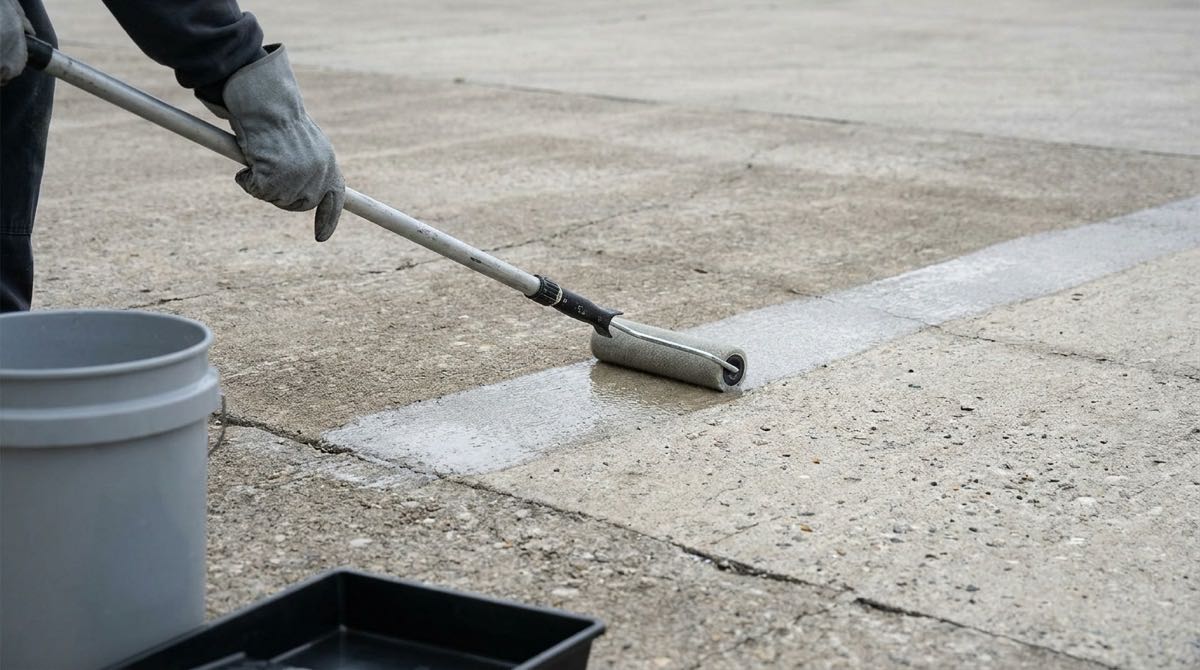
What a Bonding Primer Does on the Slab
A primer manages suction. A dry, porous slab pulls water out of the overlay the moment it goes down, and the material at the interface loses the water it needed to hydrate. You get a weak, powdery layer right where the bond is supposed to happen.
Primer soaks into that surface and controls how fast it drinks. It also wets out the profile, getting into the texture instead of letting the mix bridge over it and trap air.
That is the job. Suction control and wet-out. Nothing more.
Primer Does Not Fix Bad Prep
This is where crews get in trouble. Primer is not a bonding agent in the sense of gluing an overlay to a surface it has no business bonding to.
Put primer over laitance and you have primed the laitance. Put it over a curing compound, a sealer, or a slab with grease in it, and you have wetted out a contaminant. When that section delaminates in eighteen months, the failure plane is right where the primer was, and it looks like a primer failure. It was a prep failure the whole time.
If you want to know whether the substrate can hold an overlay at all, that is a pull-off test question, ASTM C1583, not a primer question. The near-surface tensile strength of the slab is what it is. No primer raises it. For what the failure modes look like after the fact, our guide to cracking and delamination in overlays walks through reading the break.
When You Need It
Prime when the substrate is going to fight you for water. The situations that call for it are consistent:
- Old, dry, weathered exterior concrete that has been drinking rain and drying out for years
- Any placement going down thin, where there is not enough material volume to survive losing water to the slab
- Hot, dry, or windy conditions, where the slab is already pulling and the sun is pulling from the top too
- Feathered edges, which are the first thing to dry out and the first thing to fail
- A sound but visibly porous surface, the kind that darkens instantly when you splash water on it
That water test is the cheapest diagnostic on the job. Splash a cup on the slab. If it disappears immediately, you have suction and you should be priming. If it beads or sits there, you have a different problem.
When You Can Skip It
Priming a slab that does not need it is not neutral. It costs money and it can hurt.
On a dense, hard-troweled interior floor with low porosity, primer can sit on the surface instead of soaking in, and a primer film that has not penetrated is one more layer that can shear. On a damp substrate, adding primer adds moisture to a surface that already has too much. And if the product data sheet calls for a slurry coat of the mix itself as the bond coat, use that instead. The manufacturer tested it that way.
| Substrate Condition | Water Test Result | Call |
|---|---|---|
| Old exterior, weathered, porous | Absorbs on contact | Prime |
| Hard-troweled interior, dense | Beads or sits | Usually skip, check the data sheet |
| Damp or actively wet | Already saturated | Do not prime, fix the moisture first |
| Sealed, coated, or waxed | Beads and stays | Do not prime, strip it |
| Freshly profiled and sound | Absorbs moderately | Prime for thin sections and hot days |
Primer That Dried Before the Mix Went Down
This is the most common field error and it is entirely a scheduling problem.
Primer has a window. Place into it while it is doing what it is supposed to do, and the bond is what it should be. Let it fully dry and sit for hours while the crew handles something else, and the suction comes right back. Now you have a dry primed slab that behaves close to how the unprimed slab behaved, except you also spent the material.
Prime the area you are about to place, not the whole patio at 7 a.m. Match the primed area to what the crew can cover, and check the product data sheet for the actual window instead of going off what somebody remembers from a different product.
Primer, Bond Coat, and Slurry Coat Are Not the Same Thing
The terms get used interchangeably at the counter and they should not be.
A primer is a thin liquid that penetrates and conditions the substrate. A slurry coat is the overlay mix itself, thinned and scrubbed into the surface to make the first mechanical connection. A bond coat is a general term that could mean either, which is why it causes so much confusion on a spec.
Some systems want a primer. Some want a scrubbed slurry coat of the same material. Some want both in sequence. If a spec says bond coat and nothing else, get clarification before you order, because buying the wrong one means either a wasted pail or a section that has to come back out. Primer 100 is our primer, in one gallon and five gallon.
How BonTon Supply Stocks the Bond Side of an Overlay
Priming decisions come down to the slab in front of you, which is why we would rather talk through the substrate than sell a pail on reflex. Everything is stocked with no minimum order quantities and regional delivery across Ohio and western Pennsylvania.
- Prep and finish products, including Primer 100 and the lath used where mechanical anchorage is needed
- Overlay mixes for horizontal, vertical, and smooth coat work
- Concrete repair products for slabs that need patching before an overlay is worth placing
Most bond failures traced back to primer were never about primer. They were about a substrate that was contaminated, too dry, too wet, or too weak to hold anything, and the pail just happened to be the last thing applied before the failure plane formed. If you are looking at a slab and are not sure whether it needs priming, a slurry coat, or repair before anything goes over it, tell us what the water test did. Contact us and we will work through it.