
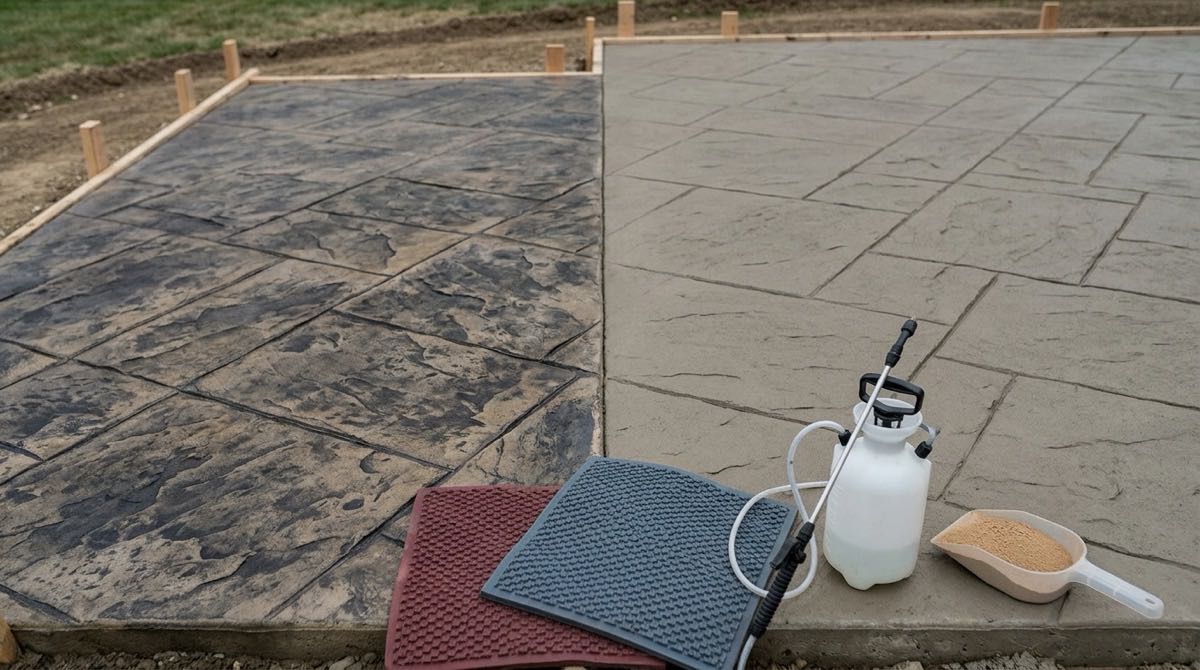
Liquid Release vs Powder Release and What Each One Does to the Finish
Release is the cheapest material on a stamped job and the one most likely to wreck it. Pick the wrong type and you either fight the mats all afternoon or spend the next morning trying to wash color out of a surface the client already saw.
Powder and liquid do the same mechanical job. They do very different things to everything after that. If you are still deciding on the finish itself, our breakdown of stamped versus stained concrete comes first. This is the step after.
What Release Does Between the Mat and the Mix
Release puts a barrier between the stamp and the surface so the mat lifts clean instead of tearing the texture back out. That is the entire mechanical function.
Powder release is a fine hydrophobic solid, broadcast onto the surface and the mats before stamping. It sits between the two and repels water. Liquid release is sprayed on, and it does the same thing chemically without adding a solid to the surface.
Both work. The argument is never about whether the mat lifts. It is about what is left behind.
The Silica and Washoff Problem With Powder
Powder release is a dust product broadcast by hand into open air, and crews breathe it. OSHA regulates occupational exposure to respirable crystalline silica in construction work, and dust-generating tasks fall under that framework. What applies to a specific product and a specific task is a question for your safety program and a qualified professional, not for a supplier counter. Read the SDS on whatever you are broadcasting and handle it accordingly.
Then there is the washoff. Powder has to come off the surface before sealing, which means pressure washing, which means colored residue going somewhere. On a residential patio that somewhere is often the lawn, the flower beds, or the storm drain. Check what your municipality allows before you spray a stamped patio into the street.
Liquid release removes both problems. No dust to breathe, no colored slurry to chase.
Powder Colors the Surface, Liquid Does Not
Here is the tradeoff nobody wants to hear. Powder release is not just a bond breaker. It is a coloring step.
Tinted powder settles into the low spots of the stamp pattern and stays there after the high points get washed. That is antiquing. It is what gives stamped work the depth and variation that makes it read like stone instead of like a rubber mat pressed into gray concrete. Liquid release gives you a uniform color with no variation at all.
If a client is paying for stone, and the surface comes out flat and monotone, you did not save time by going liquid. You created a color problem you now have to solve topically.
| Factor | Liquid Release | Powder Release |
|---|---|---|
| Application | Sprayed on surface and mats | Broadcast by hand |
| Airborne dust | None | Yes, follow the SDS |
| Color effect | None, uniform surface | Antiquing in the low spots |
| Cleanup | Minimal, no washoff slurry | Pressure wash, colored runoff |
| Overspray control | Wind can carry it onto adjacent work | Wind carries dust further |
| Best fit | Interior, tight sites, uniform color | Exterior stamped work needing depth |
Getting Depth Without Broadcasting Powder
Going liquid does not mean giving up variation. It means moving the color work to a different step.
Color the mix integrally, then build contrast topically after the stamp with a color product applied to the cured surface. You get control that powder never gives you, because you are placing the accent instead of hoping the broadcast landed evenly. It is more steps and more labor. On interior work, occupied spaces, or a tight urban site where dust is a nonstarter, it is the only workable path.
Pro Release is our liquid, and yes, it smells like bubblegum. Crews notice. It beats the alternative on an enclosed job.
Where Crews Overdo It
Too much release is more common than too little, and it causes more callbacks. Watch for these:
- Puddled liquid release sitting in low spots, which thins the surface paste and leaves a soft, dusty spot after cure
- Heavy powder broadcast right before a stamp, which packs into the pattern and resists washing out entirely
- Spraying liquid in wind that carries it onto adjacent slabs you have not stamped yet
- Re-broadcasting powder into the same area repeatedly because the mats started sticking, when the real problem is the mix setting up faster than the crew is moving
- Coating the mats so heavily that the texture reads soft and washed out
Sticking mats usually means a timing problem, not a release problem. Adding more release to fight a set that got away from you buys a few minutes and costs you the finish.
Residue Left Under a Sealer
Release is a bond breaker. That is the point. It also does not know the difference between your stamp mat and the sealer you put down two days later.
Powder residue left in the pattern is the most common cause of sealer that will not wet out or bond evenly in the low spots. It looks fine dry and shows up the moment the sealer goes on. Liquid release leaves less behind but is not zero, and it still needs a proper wash and dry before anything gets coated.
Do not seal until the surface is clean and dry all the way through the pattern, not just on the high points. Our guide to choosing the right concrete sealer covers what goes on top once the surface is ready.
How BonTon Supply Handles the Release Side of a Stamp Job
We stock the liquid side and the color products that make liquid release work on decorative jobs. No minimum order quantities, regional delivery across Ohio and western Pennsylvania.
- Prep and finish products, including Pro Release and the primers that go under an overlay
- Color products for building integral and topical color when release is not doing the coloring
- Sealers for the coat that goes on once the pattern is washed and dry
The release decision is really a color decision wearing a bond breaker’s jacket, and crews get burned when they treat it as a throwaway line on the material list. If you are working out how to hit a specific look on a stamped job without broadcasting powder on the site, tell us the pattern and the color target. Contact us and we will put the material list together.