
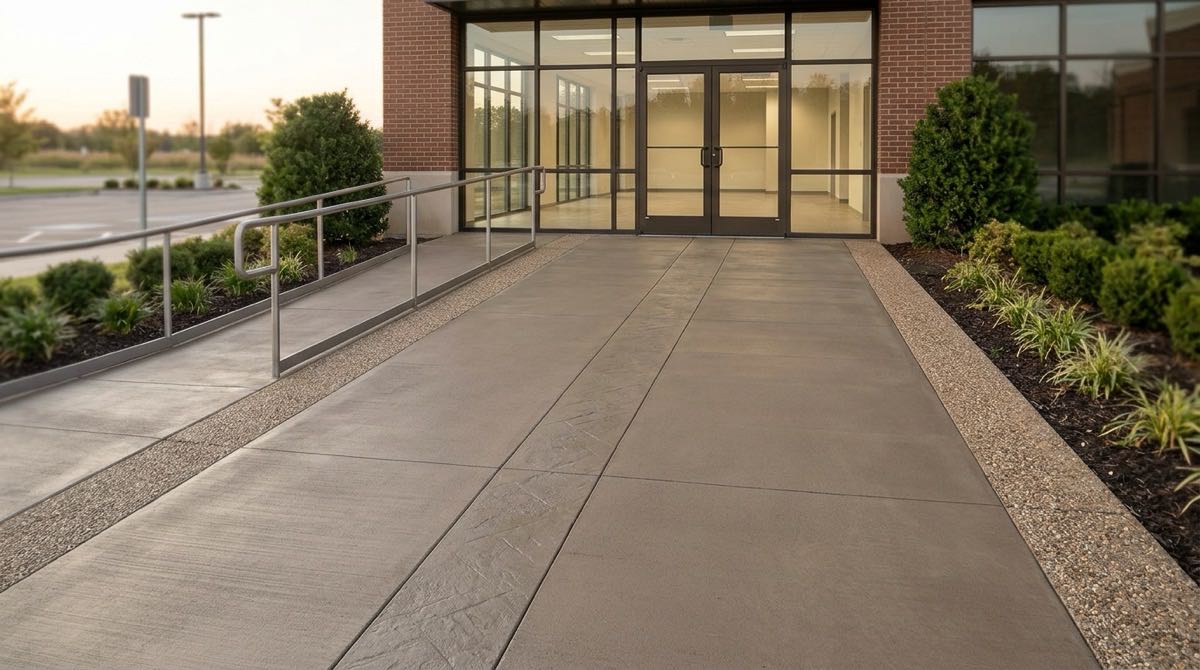
Decorative Concrete Options for Ohio Commercial Entryways and Walkways
A commercial entryway has to look good and pass inspection, and those two requirements aren’t always aligned by default. Decorative finishes can meet both, but only if accessibility requirements shape the design decision instead of getting bolted on afterward. Our piece on how to match overlay thickness to substrate condition covers the engineering side that applies just as much to commercial walkways as anywhere else.
Why Accessibility Requirements Come First
Commercial walkways and entryways are accessible routes under federal law, which means surface texture, slope, and joint width all have compliance requirements before design preference enters the conversation. The U.S. Access Board requires accessible ground surfaces to be firm, stable, and slip resistant, and while it doesn’t specify an exact minimum coefficient of friction, deeply textured or irregular finishes can create compliance risk if not evaluated carefully.
Finish Options That Work Well on Commercial Routes
- Light to medium broom-finished overlays provide reliable traction without excessive surface irregularity
- Exposed aggregate in a fine to medium gradation offers texture and traction while staying compliant
- Subtle stamped patterns with shallow relief can work, provided joint width and surface irregularity stay within tolerance
- Stained finishes with a matte or light broom topcoat add color without the surface irregularity of deep stamping
Where Design and Compliance Can Conflict
Deep stamped textures that look striking on a residential patio can create surface irregularities that exceed what’s appropriate for an accessible commercial route. This is a case where a finish that would be a strong choice residentially needs to be reconsidered or adjusted commercially, not simply avoided altogether.
Other Practical Considerations for Entryways
- Consistent, flush transitions between different pavement sections or materials
- Adequate slope for drainage without exceeding accessible route slope limits
- Joint width and spacing that stays within compliant tolerances
- Color and texture that align with branding without compromising slip resistance
Balancing Curb Appeal With Compliance
A commercial entryway is often a business’s first impression, which makes the temptation to prioritize style understandable. But a beautiful entry that creates a compliance liability costs more in the long run than a slightly more conservative finish that meets both goals from the start.
How BonTon Supply Supports Commercial Entryway Projects
Matching a decorative finish to both a client’s design goals and accessibility requirements takes product knowledge that goes beyond a standard residential recommendation.
Check the FAQ for finish-specific questions, or browse the gallery for examples of commercial entryway work.
- Guidance on finishes that balance texture, traction, and compliance
- Product recommendations suited to accessible commercial routes
- Stone Edge systems that hold up under high foot traffic
A commercial entryway that looks sharp and meets code starts with the right finish decision, not a compromise made after the fact. BonTon Supply helps Ohio contractors get both right. Browse the shop or request a quote to talk through your next project.